
Micro-Scratches on Dental Guards: How They Form and What They Do
Share
by Leon Schmidt, SonicSmile · 4 min read · Dental Guards & Material
Your guard used to be crystal clear. Now it's milky, it smells and it somehow looks used. And yet you clean it every day.
The cause is almost always the same — and you can't see it. Micro-scratches. Tiny grooves in the plastic, barely wider than a hair, that build up over weeks and ruin the guard from the inside out.
Here's how they form, what they really do — and how to avoid them.
What Micro-Scratches Are
Micro-scratches are fine grooves on the surface of the guard plastic, barely visible to the naked eye. The thermoplastic that aligners, retainers and night guards are made from is deliberately soft — which makes it vulnerable to anything harder than itself.
Individually, these scratches would be harmless. The problem is that they add up. Every day of the wrong cleaning adds new ones, until the surface is covered by a network of fine grooves — and that changes everything.
The key point: Micro-scratches are irreversible. Unlike staining or biofilm, they can't be cleaned away. What's scratched stays scratched – which is why avoidance is the only strategy that really works.
How Micro-Scratches Form
Toothbrush. The most common culprit. Bristles – even soft ones – are harder than the guard plastic and scratch the surface with every brushing.
Toothpaste. Contains abrasives meant to remove staining from teeth. On the guard they act like fine sandpaper – especially damaging combined with the toothbrush.
Baking soda. Often recommended online as a home remedy. It's abrasive and leaves scratches too.
Harsh drying. Rubbing with rough towels or paper towels can cause fine scratches. Better to let it air-dry.
What Micro-Scratches Do
They make the guard cloudy. A smooth surface lets light pass straight through – the guard looks clear. A scratched surface scatters light in all directions, and the guard appears milky and matte. This isn't dirt that can be cleaned away, but the structure itself.
They become bacteria hideouts. Biofilm and bacteria collect in the grooves – so deep that neither rinsing nor a cleaning tablet fully reaches them. This is the real reason a scratched guard smells permanently.
They accelerate staining. Pigments from coffee, tea and food settle into the grooves more than on a smooth surface. A scratched guard yellows faster and deeper.
Scratched vs. Intact
| Property | Scratched guard | Intact guard |
|---|---|---|
| Transparency | Milky, matte | Clear |
| Bacteria | Sit deep in grooves | Easily rinsed off |
| Odour | Permanent, keeps returning | Neutral |
| Staining | Fast & deep | Slow, surface-level |
How to Avoid Micro-Scratches
The rule is simple: nothing harder or more abrasive than the plastic should touch the guard. No toothbrush, no toothpaste, no baking soda, no rough towels.
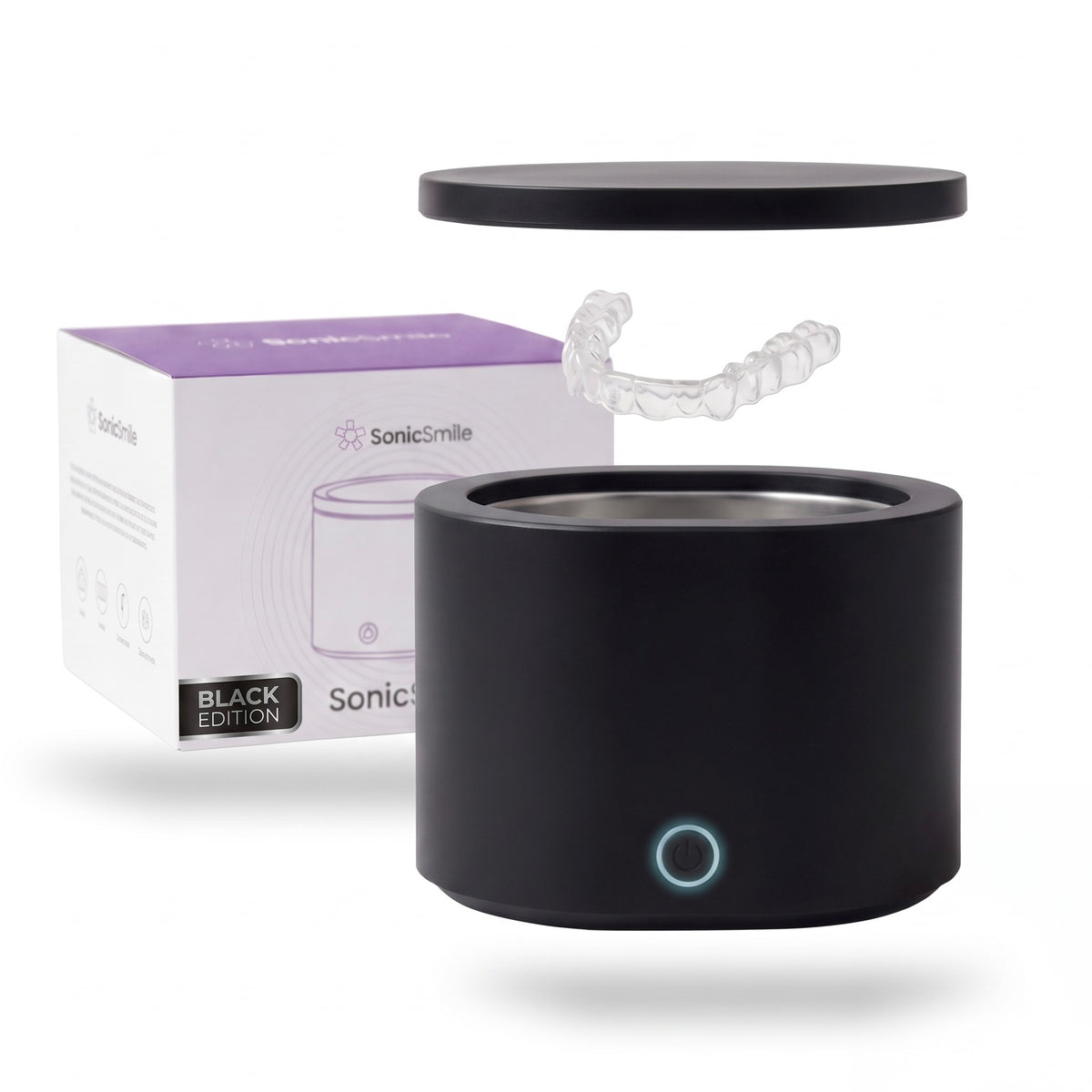
Clean without contact instead: the Sonic One™ ultrasonic cleaner dislodges biofilm with sound waves without touching the surface – no abrasion, no new scratches. Combined with a Sterilising Tablet, the guard is disinfected at the same time. That way it stays clear for as long as it's worn.
Frequently Asked Questions
Can micro-scratches be removed?
No. Micro-scratches are physical damage to the surface and irreversible. You can only prevent new ones and remove the biofilm from the existing grooves as well as possible – which works best with ultrasonic. With aligners the problem resolves with the next tray; with retainers and night guards, a replacement is worthwhile if heavily scratched.
How do I tell if my guard is scratched or just dirty?
With the wet test: hold the guard under cold water. If it looks clear again when wet, it's biofilm or deposits – cleanable. If it stays milky and cloudy even when wet, it's scratches in the structure that can't be removed.
Does the ultrasonic cleaner scratch the guard too?
No. Ultrasonic cleans without contact – there's no mechanical contact with the surface. The cavitation bubbles dislodge the dirt without anything ever rubbing against the plastic. That's exactly why ultrasonic is the gentlest method.
How quickly do micro-scratches form?
Immediately and continuously. Even the first brushing with a toothbrush leaves fine scratches, and every further day adds more. The guard usually becomes visibly cloudy after a few weeks of the wrong care – by which point the damage is already done.
Scratch-Free Cleaning
Sonic One™ – Ultrasonic Cleaner
Dislodges biofilm without contact using sound waves – no abrasion, no new scratches. The only method that keeps the guard clear for its entire wear time.
View Product →