
Why Many Cleaning Tablets Damage Your Dental Guard
Share
by Leon Schmidt, SonicSmile · 4 min read · Cleaning Tablets & Material
Cleaning tablets seem like the easy solution: tablet in the water, guard in, done. And in principle that's true. The only problem: not every tablet is made for dental guards — and the wrong one can harm the guard more than help it.
Many cheap denture cleaners from the pharmacy are too aggressive for the soft plastic of modern aligners and guards. Here's what you should watch for — and what makes a genuinely gentle cleaning tablet.
The Problem With Standard Denture Cleaners
Most classic denture cleaners were developed for dentures — meaning hard materials made of acrylic or with metal parts. Dental guards, aligners and retainers, by contrast, are made from soft thermoplastic that's considerably more sensitive.
Many of these cleaners contain aggressive or abrasive ingredients and stronger bleaching agents meant for robust dentures. On a soft guard they can roughen the surface, cloud the plastic and make the material porous over time. What works for the denture is too much for the aligner.
Particularly tricky: the damage isn't immediately visible. Only after a few weeks of regular use does it show that the guard turns cloudier and stains faster — and by then it's too late.
The core point: A cleaning tablet should clean chemically – dissolve deposits, not attack the material. Anyone reaching for an aggressive denture cleaner trades a hygiene problem for a material problem.
Why Chemistry Beats Mechanics
There are two ways to clean a guard: mechanically (scrubbing) or chemically (dissolving). Mechanical cleaning with a toothbrush leaves micro-scratches where bacteria resettle. That's exactly why chemical cleaning with a tablet is fundamentally the gentler choice — it dissolves deposits without touching the surface.
Provided the chemistry is right. A good cleaning tablet has to do two things at once: work thoroughly against bacteria and deposits — while staying gentle on the material. That balance is the real art.
What to Watch For in Cleaning Tablets
| Criterion | Avoid | Look for |
|---|---|---|
| Developed for | Hard dentures | Dental guards & aligners |
| Material effect | Abrasive / corrosive | Non-abrasive, non-corrosive |
| Metal parts | Often not suitable | Safe for retainers with metal |
| Residue / taste | Chemical film, bitter aftertaste | No film, fresh taste |
Our Sterilising Tablets – Gentle and Thorough at Once
This is exactly why we developed our Sterilising Tablets specifically for dental guards — not for hard dentures. The formula was tuned together with experts to clean thoroughly without attacking the material: explicitly non-corrosive and non-abrasive, and safe even for retainers with metal parts.
Rather than working mechanically, the tablets dissolve deposits chemically — with active oxygen that removes up to 99.9% of odour-causing bacteria within 15 minutes. And instead of a chemical film or bitter aftertaste, real peppermint oil leaves a subtle, fresh mint note.
The ingredients at a glance: sodium bicarbonate and sodium percarbonate as a gentle oxygen base, potassium peroxymonosulfate and TAED as cleaning activators, citric acid, PEG-150, sodium lauryl sulfate, sodium benzoate and real peppermint oil for freshness. A formula designed for effectiveness and material protection at the same time.
Suitable for all removable guards: aligners, retainers (including those with metal), braces, mouthguards, dentures, and bite and night guards.
Frequently Asked Questions
Can I use normal denture cleaner tablets for my dental guard?
Better not regularly. Many standard denture cleaners are made for hard dentures and contain more aggressive ingredients that can roughen and cloud the soft plastic of aligners and night guards. For ongoing care, choose a tablet explicitly developed for dental guards and labelled non-abrasive and non-corrosive.
How can I tell if a tablet is gentle on the material?
Look for the labels "non-abrasive" and "non-corrosive", and for a note that the tablet was developed specifically for dental guards (not just dentures). Another indicator: if it's explicitly cleared for retainers with metal parts, that points to a gentle formulation.
What are the main ingredients of the Sterilising Tablets?
The cleaning effect is based on active oxygen from sodium percarbonate, activated by TAED and potassium peroxymonosulfate. Added to that are sodium bicarbonate, citric acid and mild auxiliary ingredients, plus real peppermint oil for freshness. The formula is designed for thorough yet material-friendly cleaning.
How often should I use the Sterilising Tablets?
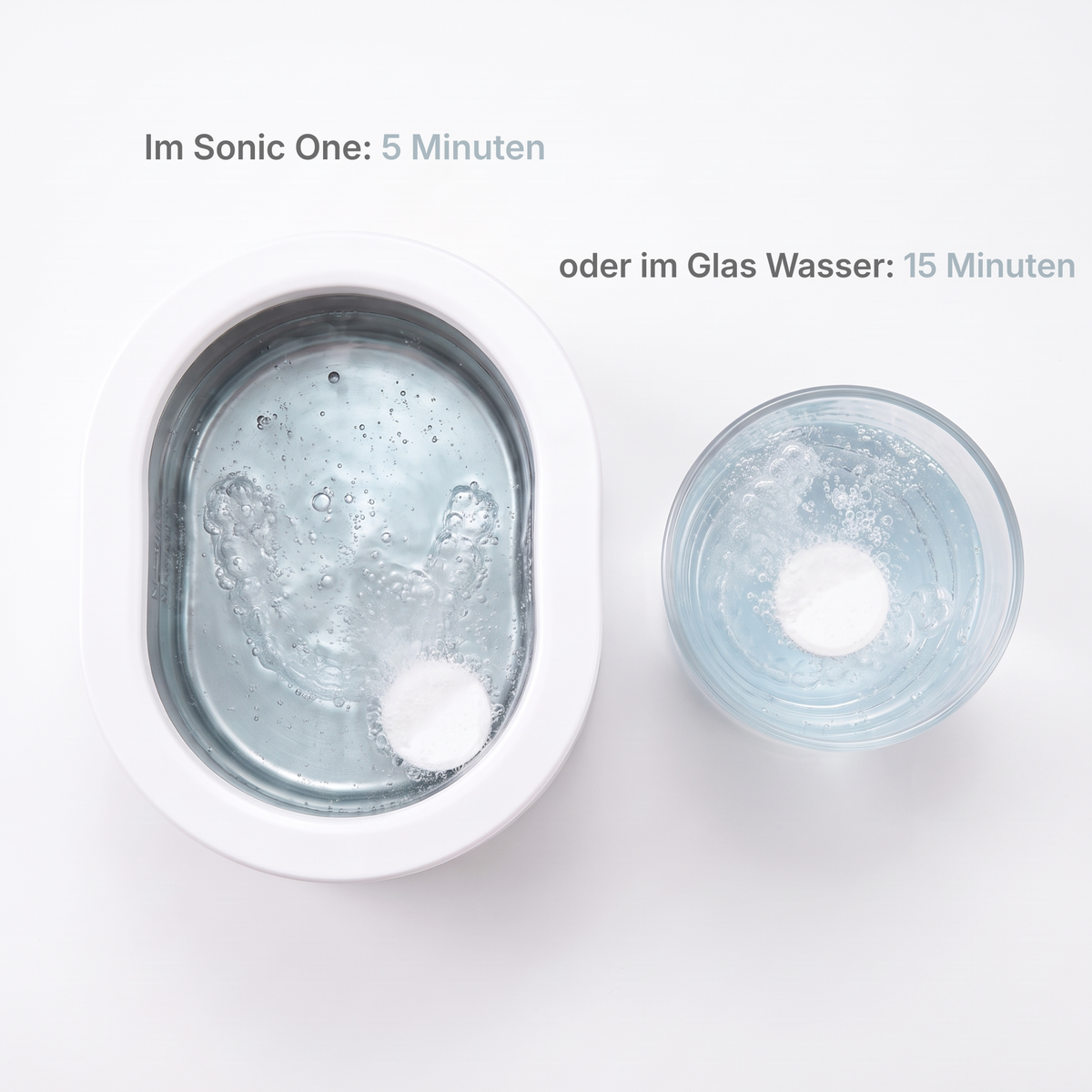
We recommend at least every two days, and daily for a particularly thorough clean. Soak for 15 to 20 minutes in a glass of lukewarm water, or a 5-minute cycle in the Sonic One™ ultrasonic cleaner. Always rinse thoroughly with clean water afterwards.
Do the tablets leave a taste on the guard?
No – quite the opposite. Unlike some aggressive cleaners that leave a chemical film or bitter aftertaste, the real peppermint oil provides a subtle, fresh mint note. After rinsing, no unpleasant taste remains.
Gentle by Design
Sterilising Tablets
Developed specifically for dental guards – non-corrosive, non-abrasive, safe for retainers with metal. Remove 99.9% of bacteria with active oxygen and real peppermint oil, without attacking the material.
View Product →