
How to Clean a Night Guard – The Complete Guide
Share
by Leon Schmidt, SonicSmile · 6 min read · Night Guard & Care
A night guard — also known as a bite guard or grinding guard — sits in your mouth night after night. It protects your teeth from the effects of nighttime grinding. But unlike Invisalign wearers, who can ask their orthodontist for advice, most people are left on their own when it comes to care — and often use methods that do more harm than good.
The result: the guard turns yellow, smells unpleasant or develops a cloudy film. It does not have to be that way. Here is how to clean your night guard properly — and which common tips you should rather ignore.
Why night guards need special care
A night guard is worn for several hours every night — directly on your teeth, in the warm, moist environment of your mouth. Exactly where saliva flow decreases at night and bacteria find ideal conditions. The result: a biofilm made of bacteria, saliva residue and deposits quickly forms on the guard.
If this biofilm is not removed daily, the consequences go beyond an unpleasant appearance: a poorly maintained guard can promote bad breath, gum inflammation, tooth decay and even fungal infections — because the bacteria are placed directly back onto your teeth and gums every night.
Night guards made of soft or hard plastic are also particularly prone to scratches and discolouration — which makes the cleaning method crucial.
The most important rule: Never use hot water — temperatures above 40 °C can permanently deform the guard and ruin its fit. Also: always clean it directly after wearing, not only in the evening before putting it back in.
The most common mistakes — and why they are harmful
Toothpaste and toothbrush. The most common tip online — and one of the most damaging. Toothpaste contains abrasive particles that scratch the surface of the guard. Even more bacteria collect in these micro-scratches, and over time the guard becomes cloudy and milky. What is meant as cleaning makes the problem worse in the long run.
Vinegar and citric acid. These are often recommended as “natural” cleaning agents. The problem: in higher concentrations, the acid attacks the plastic, makes it porous and can damage it over time. What removes deposits in the short term damages the material in the long term.
Conventional denture cleaners. The cheap tablets from the drugstore are usually made for hard dentures made of acrylic or ceramic. They often contain bleaching agents in concentrations that can roughen and cloud plastic dental guards.
Soaking for hours. Anyone who forgets their guard in a cleaning solution overnight or for several hours risks discolouration and material damage. More time does not mean more cleanliness — most cleaners work fully within 10 to 15 minutes.
What really works
The best method for night guards combines two principles: chemical cleaning with special cleaning tablets and — for maximum hygiene — physical deep cleaning with ultrasound.
Cleaning tablets for dental guards dissolve in water, release active oxygen and remove bacteria, deposits and odours — without attacking the plastic. It is important that the tablets are specifically developed for dental guards — not conventional denture cleaners. Our Sterilising Tablets are made exactly for this: bactericidal and fungicidal, non-corrosive, non-abrasive, with real peppermint oil for long-lasting freshness — and explicitly suitable for bite guards and night guards.
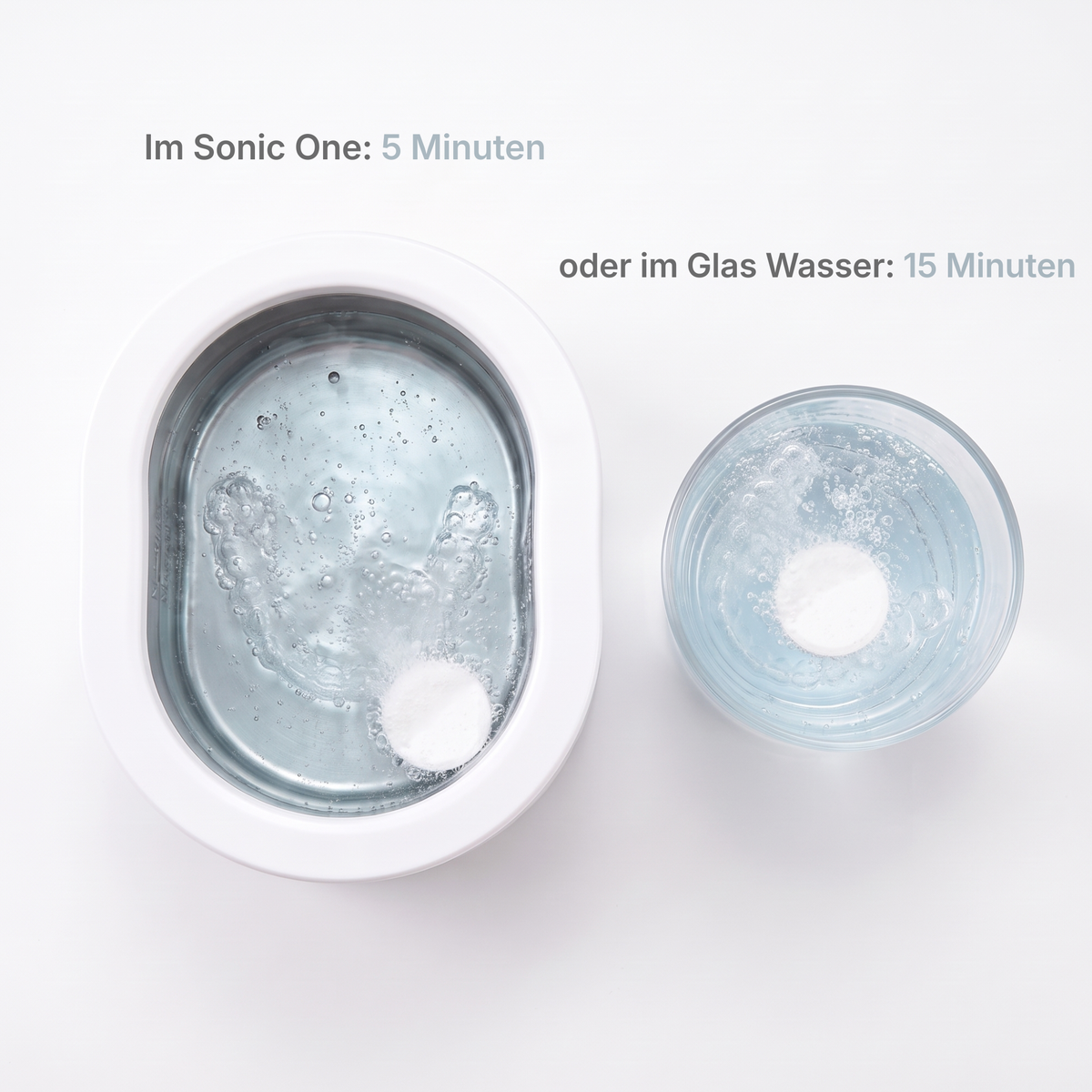
Ultrasonic cleaning goes one step further: the Sonic One™ creates tiny pressure bubbles in the water through high-frequency vibrations, loosening biofilm and deposits even from micro-cracks — areas that a tablet alone cannot reach. When you add a Sterilising Tablet to the water of the ultrasonic cleaner, you combine both effects: physical deep cleaning and chemical disinfection at the same time, in just 3–5 minutes.
Cleaning methods compared
| Method | Effect | Gentle on the material? |
|---|---|---|
| Toothpaste + brush | Surface-level | No – causes scratches |
| Vinegar / citric acid | Removes limescale | No – attacks plastic |
| Conventional denture cleaners | Disinfects | Partly – often contains bleaching agents |
| Special dental guard tablets | Bactericidal + fungicidal | Yes |
| Ultrasound + tablet | Deep cleaning + disinfection | Yes – contactless |
The right routine for your night guard
In the morning after wearing: Remove the guard directly after waking up and clean it — not only in the evening. Most bacteria have formed overnight. Briefly rinse the guard under cold water, then place it in the ultrasonic cleaner with one Sterilising Tablet. 3–5 minutes, done.
If you do not have an ultrasonic cleaner: Dissolve one Sterilising Tablet in lukewarm water, soak the guard for 10–15 minutes, then rinse thoroughly with clean water. Do not soak longer than necessary.
Storage during the day: Store the guard in a ventilated storage box — never loose in a bag or wrapped in tissues. Important: store it slightly moist, not completely dry, as some guards can deform if they dry out completely.
Clean the box as well: Clean the storage box once a week too — it also collects bacteria. Simply place it together with the guard in the tablet solution or ultrasonic cleaner.
For optimal hygiene, we recommend cleaning the guard with Sterilising Tablets at least every two days — or daily if worn every night.
Frequently asked questions
My night guard is already yellow — can I get it clean again?
In many cases, yes. Light yellowing and deposits can often be significantly reduced with several ultrasonic cycles and one Sterilising Tablet. For heavier discolouration, two to three days of consistent cleaning can help. What cannot be fixed: deep scratches caused by previous cleaning with toothpaste — these remain. In cases of very strong, ingrained discolouration, replacing the guard at the dentist may make sense.
How often should I clean my bite guard?
A quick clean should be done daily directly after wearing. We recommend a more thorough cleaning with Sterilising Tablets at least every two days — or daily if needed. If you only rinse the guard with water, you remove surface-level saliva, but not the biofilm responsible for odour and yellowing.
Can I clean the guard with the same tablets as my aligner?
Yes. Our Sterilising Tablets are developed for all removable dental appliances — aligners, retainers including those with metal parts, braces, mouthguards, dentures as well as bite guards and night guards. One tablet, all types of dental appliances.
Why does my night guard smell even though I clean it?
Odour is caused by bacteria that sit deep in the microstructure of the plastic. If you only rinse it or clean it with a toothbrush, surface dirt is removed — but the deep-seated bacteria remain. Ultrasonic cleaning with one Sterilising Tablet reaches these bacteria and removes the odour at its source.
When do I need a new night guard?
That depends on how strongly you grind your teeth at night. People who grind very heavily may need a new guard after just six months. With moderate use and good care, a night guard can last several years. Signs that replacement is needed include visible cracks, worn-through areas or deformation. Proper cleaning significantly extends its lifespan.
Our recommendation
Sterilising Tablets
Specially designed for dental guards — including bite guards and night guards. Bactericidal, fungicidal, non-abrasive, with real peppermint oil. Removes 99.9% of bacteria and odours.
View product →For maximum hygiene
Sonic One™
Ultrasonic cleaner for deep cleaning — combined with one Sterilising Tablet, the most thorough method for your night guard.
View product →